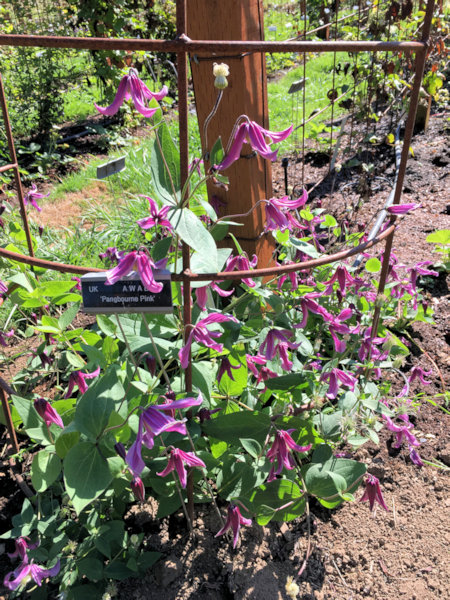
Introduced in 1992, Clematis 'Pangbourne Pink' (syn. C. integrifolia 'Pangbourne Pink') was a relatively early selection of 'Rosea' (Integrifolia Group). By early, I refer to the renaissance of the genus Clematis that began around that time and continues to this day. Its creation was initially credited to Busheyfields Nursery in Kent, UK, but as of 2006 is attributed to A. W. A. Baker, of whom little is known except the obvious, that this person had a keen eye for exceptional herbaceous perennial clematis.
When I visited Rousham House in Oxfordshire in 1998, a William Kent garden he remodeled in the 18th century, I will admit to feeling a bit cranky. Landscape gardens are not my thing, and the allotted visit of 90 minutes, where one was expected to rush from one vista to another, gave me the sulks. I'm an unrepentant flower gardener. I've been told I will come to appreciate the stately grandeur of such places, but I'm now beyond calling myself middle-aged with a straight face, and my tastes have not changed. When I heard there was a perennial border at Rousham, I made a beeline for it. It was there that I met C. 'Pangbourne Pink'. Suddenly a 90-minute visit with my new best friend was not enough.
That specimen was no more than 45cm tall, but spread lushly to a meter across, positioned to flounce over the edge of the border onto the broad paved path. This was the pinkest C. integrifolia form I had yet seen in person, and I was determined to find it in the US upon my return. In his 1995 book, "Making the Most of Clematis" (third edition), Raymond Evison describes it as "stunning".
Brewster Rogerson acquired his first specimen of it when Portland area nurseryman Bob Gutmann picked it up, and for a time in the late 1990s and early 2000s it was easy to find locally and around the US through Chalk Hill Clematis in California. It seems likely that C. 'Pangbourne Pink' has been used to produce newer pink C. integrifolia hybrids and selections. The resemblance is quite strong, both color and texture, in Raymond Evisons' C. 'Evipo012' JESSICA (original trade designation was MEDLEY in 2003), although JESSICA may get twice as tall.
C. 'Pangbourne Pink'
At the Rogerson Clematis Garden, it lives in two widely different areas of the garden. In the Modern Garden, it decorates the end of a row with rich soil and regular watering. In the Steppe Garden, it has been assigned the furthest southwest corner of the entire Garden, in hot sun from noon to sunset, where it doesn't always get first crack at water and fertilizer and is sometimes swamped by C. ladakhiana. It has a gravel mulch, too, which prevents the pooling of water around the crowns of clematis that don't need nearly as much water as our climate provides before the rain stops from June to October. Regardless of these hardships, it flowers courageously over a long season. When we remember, it — and most of our non-climbers from the C. integrifolia clan — gets hard pruned in mid-to-late July for easy late August through September rebloom.
Our robust and undaunted Steppe Garden specimen of C. 'Pangbourne Pink' reminds me of the quote attributed to William Kent, "Garden as though you will live forever". Or as C. 'Pangbourne Pink' would have it, "Grow as though you will live forever".


 Linda Beutler